TM Indianapolis • First Responder Initiative

Deep Rest for the Best

Firefighters are famously proud of their equipment.

Go into your neighborhood fire station and expect to see polished chrome and boots placed just so. Each firefighter also trains every muscle and sinew to meet sometimes superhuman demands (think of the firefighters you see climbing and carrying heavy loads up flights of stairs, while everyone else races to get to ground level). All this is on the outside and visible.

In Indianapolis, you can help gift 10% of the Indianapolis Fire Department (IFD)—approximately 130 people—with instruction in the Transcendental Meditation® technique, an evidence-based simple system of deep meditation that creates the inner, invisible complement—healthy, orderly brains developed from the inside out.

These 130 front-line first responders have a staggering collective total of 11 trillion brain cells all of us rely on to work in unison and precision, just like every other piece of modern firefighting gear, to ensure public safety. We can build a lifeline through the TM® technique for these men and women who provide lifelines for us every day.

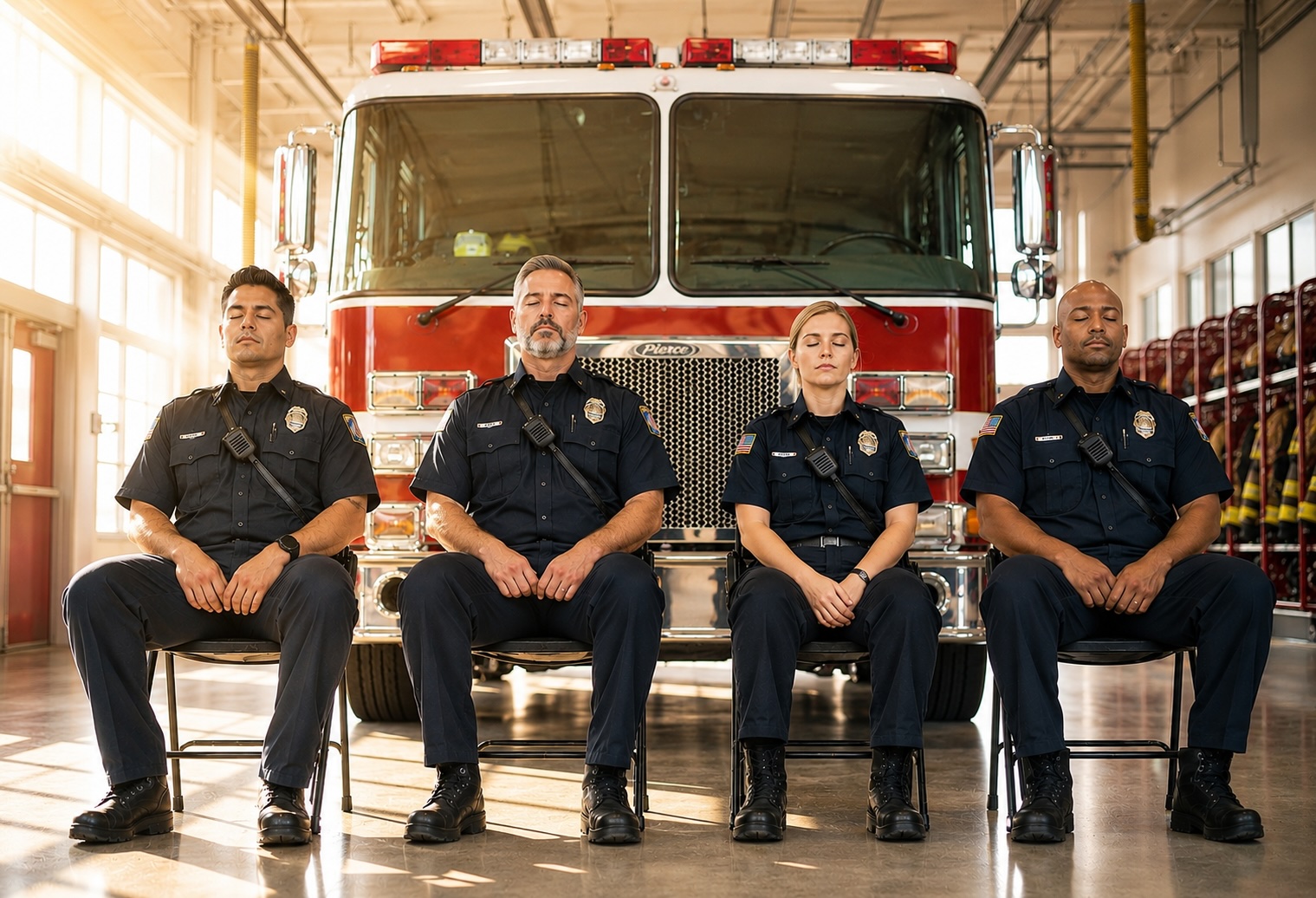
Four firefighters seated meditating in front of a fire truck inside a fire station

IFD is recognized nationally and even internationally as one of the most advanced fire departments, and the TM® technique is a cornerstone tool the department can use from the inside out to build resilience, reduce trauma, and improve performance.

The Need

Repeated exposure requires scalable support.

Firefighters experience repeated exposure to trauma, leading to elevated rates of post-traumatic stress disorder (PTSD), anxiety, depression, substance use disorder, and suicide. Departments nationwide are prioritizing scalable, evidence-based mental health solutions that improve both well-being and operational performance.

The Solution

A simple technique, taught personally, with lifetime support.

The TM® technique is a simple, natural, effortless mental technique practiced sitting comfortably in a chair with eyes closed. It requires no concentration or lifestyle change and can be integrated into demanding schedules easily.

Over 10 million people from all walks of life have learned the technique since the 1950s. More than 400 published research studies have been conducted at over 250 independent research institutions and universities. The efficacy of TM® for treatment of PTSD has been examined extensively.

The standardized institutional course spans four consecutive days (approximately 5.5 hours), with four scheduled followups over three months and free lifetime support across the US.

The Goal

$100,000 will support training for 10% of the Indianapolis Fire Department, approximately 130 people, with zero out-of-pocket costs.

Thanks to existing donations, $3,120 is already available, enough to train 4 additional firefighters. To date, TM® certified instructor Paul Wilson has taught 15 IFD members at various organizational levels, beginning in November 2024.

15 IFD members taught to date
4 additional firefighters currently funded
130 10% goal
Progress toward 130 firefighters 19 / 130


How to Donate

If you can support Deep Rest for the Best, to pay with credit card, please visit the online payment portal at TMFriends.org.

Please contact Paul (317-620-1008 / pwilson@tm.org) when you donate so he knows it is earmarked toward Deep Rest for the Best. Whether funding arrives in small or large packages, every penny will stay local and count. All donations to the Indianapolis donations account are tax deductible and used exclusively for promotion of TM® and scholarships for those in need who want to learn. Depending on demand for Deep Rest for the Best instruction, the goal will be allocating funds raised for this project specifically for full scholarships for firefighters or other front-line first responders.

If, instead, you want to send a check, please make it payable to "Maharishi Foundation USA" and mail it to:

Attn: Paul Wilson
Indianapolis TM Center
911 East 86th Street, Ste 108
Indianapolis, IN 46240

Indicate on the memo line that it is for Indianapolis, and, as requested above, please write to or text Paul about your donation.

A padded envelope rather than a business envelope is a good idea to ensure safe delivery.

Please forward this site to anyone you know who might be moved to help. Indianapolis can be a template for other cities in the US, and Deep Rest for the Best can be extended in time to other front-line first responders and their families through your generosity.

National and Local Implementation

Already active in major departments.

TM® programs are active in major departments, including FDNY, NYPD, and LA County FD, and are being integrated into behavioral health and addiction recovery programs. Leadership from FDNY and IAFF has helped expand these programs nationally.

“Transcendental Meditation gives firefighters a powerful tool to reduce stress, build resilience, and stay mentally strong on the job.”
— Salvatore Cassano, FDNY Commissioner (Ret.), National Chairman TM for Firefighters

Indianapolis Voices

Testimonials from IFD members

This is a 47-minute interview, provided courtesy of TM Talks, with Battalion Chief (Ret.) Doug Abernathy, describing his experience with the TM® technique and his vision for sharing it with his brothers and sisters in public safety. It begins at 15 minutes in, but the whole interview is worth watching.

“The greatest gift I’ve been given in a long time is Transcendental Meditation.” — Doug Abernathy,
IFD Battalion Chief (Ret.), Peer Support, Health & Safety Training

Matt Henss

IFD Chief of Administration
instructed June 2025,
audio, 6.5 minutes

Steve Clegg

IFD Division Chief, Director of Training
instructed December 2025,
audio, 2 minutes

Dudley Taylor

IFD Battalion Chief • instructed July 2025

I recently began practicing Transcendental Meditation, and I can genuinely say it has been a transformative journey—both physically and mentally. What initially started as simple curiosity quickly turned into a daily ritual that has helped me reconnect with my body on a deeper level.

Unlike other forms of meditation that focus solely on the mind, Transcendental Meditation uniquely emphasizes the mind–body–spirit connection. I’ve noticed significant improvements in my sense of emotional clarity. I view it as layer of mindfulness and balance I didn’t know I needed.

One of the most profound changes is how grounded and centered I feel after each session. Whether I’m dealing with stress, brain fog, or just a hectic day, this practice helps me reset. The technique is gentle yet deeply effective—softening breath and gaining subtle awareness and stillness that fosters inner harmony.

I wholeheartedly recommend Transcendental Meditation for anyone looking for a holistic approach to wellness. It’s a refreshing practice that nurtures not just the mind but the entire self.


Opinions expressed in these testimonials do not necessarily represent those of the TM® program.

Program Highlight

FDNY Addiction Transition Program

In collaboration with Salvatore Cassano, Commissioner FDNY (Ret.), National Chairman TM for Firefighters, the David Lynch Foundation launched a pilot program with the FDNY Counseling Services Unit (CSU) in 2023, and over 300 FDNY members have participated, including active duty and retired firefighters/EMS, peer counselors, CSU counselors, medical staff, and family members. Notably, the foundation has integrated with the CSU Addiction Transition Program, teaching TM® to a monthly cohort of members experiencing substance use disorder.

Funding Precedent

Support models already exist.

Funding sources for instruction in the US have included:

FDNY FoundationSouth Metro Fire RescueNYPD FoundationBrighton Fire DepartmentFront Range Fire and RescueEvans Fire Protection DistrictThompson Valley EMSLETA Communications (dispatch service)La Salle Fire ProtectionFrederick-Firestone Fire DistrictWest Metro Fire RescueHerndon Virginia Police Department

The NIH and US DoD have awarded nearly $35 million in grants to research the benefits of TM® technique on PTSD, anxiety, burnout, and resilience.

Expected Outcomes

Based on results at FDNY, San Francisco Fire Department, and Front Range Fire and Rescue in Colorado, expected outcomes at one month include:

93–94%overall satisfaction
71–92%reduced stress
61–82%improvements in sleep
67–100%compliance

Why This Matters

Readiness, retention, healthcare costs, and community safety.

Improving firefighter mental health directly affects department readiness, retention, healthcare costs, and community safety. This program offers a practical, scalable solution with measurable outcomes.

Research on TM® and PTSD

Published studies and program evaluation context

To understand the transformative impact of TM® on the lives of individuals with PTSD, it helps to hear directly from firefighters, paramedics, and mental health staff who have participated in these programs.

In this 4-minute video, mental health staff at the FDNY Counseling Services Unit and firefighters and paramedics they serve discuss their experiences with the TM® technique.

Additional qualitative program evaluations are available from FDNY, San Francisco Fire Department, and Front Range Fire and Rescue.

Below are summaries of some of the most important published studies on TM® for PTSD. Although these studies provide compelling data that TM is a highly effective, non-trauma-focused intervention, they cannot fully convey the lived experience and personal transformation reported by many participants.

Lancet Psychiatry (2019)

This $2.4 million Department of Defense-funded randomized controlled trial (RCT) looked at PTSD and depression in 203 veterans with PTSD at the San Diego VA Medical Center. It compared TM® with Prolonged Exposure (PE), one of the VA’s first-line treatments for PTSD, and a PTSD education program. Because many people with PTSD cannot endure PE or drop out due to having to reexperience traumatic events as part of the treatment, DoD wanted to see if a non-trauma-focused intervention could work as well.

  • 61% of the TM® group experienced clinically meaningful improvement
  • 42% of the PE group experienced clinically meaningful improvement
  • 32% of the education group experienced clinically meaningful improvement

The results caused the researchers to conclude that TM® is non-inferior to PE as a PTSD treatment. The New England Journal of Medicine’s “Journal Watch” listed this as one of 2019’s top 10 psychiatric publications.

Journal of Traumatic Stress (2021)

This RCT compared TM® to treatment as usual for veterans with PTSD at the Northwell Unified Behavioral Health Center for Military Veterans. The TM® group had large and significant improvements compared to controls in PTSD symptoms, anxiety, depression, and insomnia.

Military Medicine (2016)

This quasi-experimental design study on the DoD-funded TM® program at the Traumatic Brain Injury Clinic at Eisenhower Army Medical Center at Fort Gordon included 74 active-duty service members with PTSD or anxiety disorder. Half the service members practiced TM® voluntarily and regularly in addition to other therapies; the other half did not.

  • TM® meditators: 83.7% stabilized, reduced, or stopped using medication. 10.9% increased
  • Non-meditators: 59.4% stabilized, reduced, or stopped using medication. 40.5% increased

Medicina (2024)

Partners sometimes ask why they should adopt TM® when there are so many other forms of meditation. A recently published meta-analysis examining 61 studies of different types of meditation on PTSD symptoms helps answer that question. The analysis found that on average, PTSD improved by 1.13 standard deviations in the TM® studies. In studies of other forms of meditation, PTSD symptoms improved by no more than 0.65 standard deviations.

  • TM® (18 studies)
  • Mindfulness-Based Stress Reduction (13 studies)
  • other mindfulness techniques (16 studies)
  • a grouping of techniques that were not mindfulness-based (14 studies)

Note that although this analysis suggests TM® is more effective at treating PTSD than other forms of meditation, a meta-analysis of only 61 studies of varied design is not definitive. To make that claim, researchers would have to run trials comparing TM® to other forms of meditation directly.

Local instruction and national support

Paul Wilson (317-620-1008 / pwilson@tm.org) is the program’s local certified instructor, with nearly 700 students since 2015. He has the support of a national 501(c)(3) organization, David Lynch Foundation, including best practices for institutional courses and access to other qualified instructors as the need arises.

Press release: https://tmindy.org/DRftB_pr.pdf